Church
He chose unity over personal loyalty.
Influence
A friar who held no office of government, yet carried weight in the great decisions of his age: the unity of the Church, the succession to the Crown of Aragon and peace between warring factions.
1378 – 1417
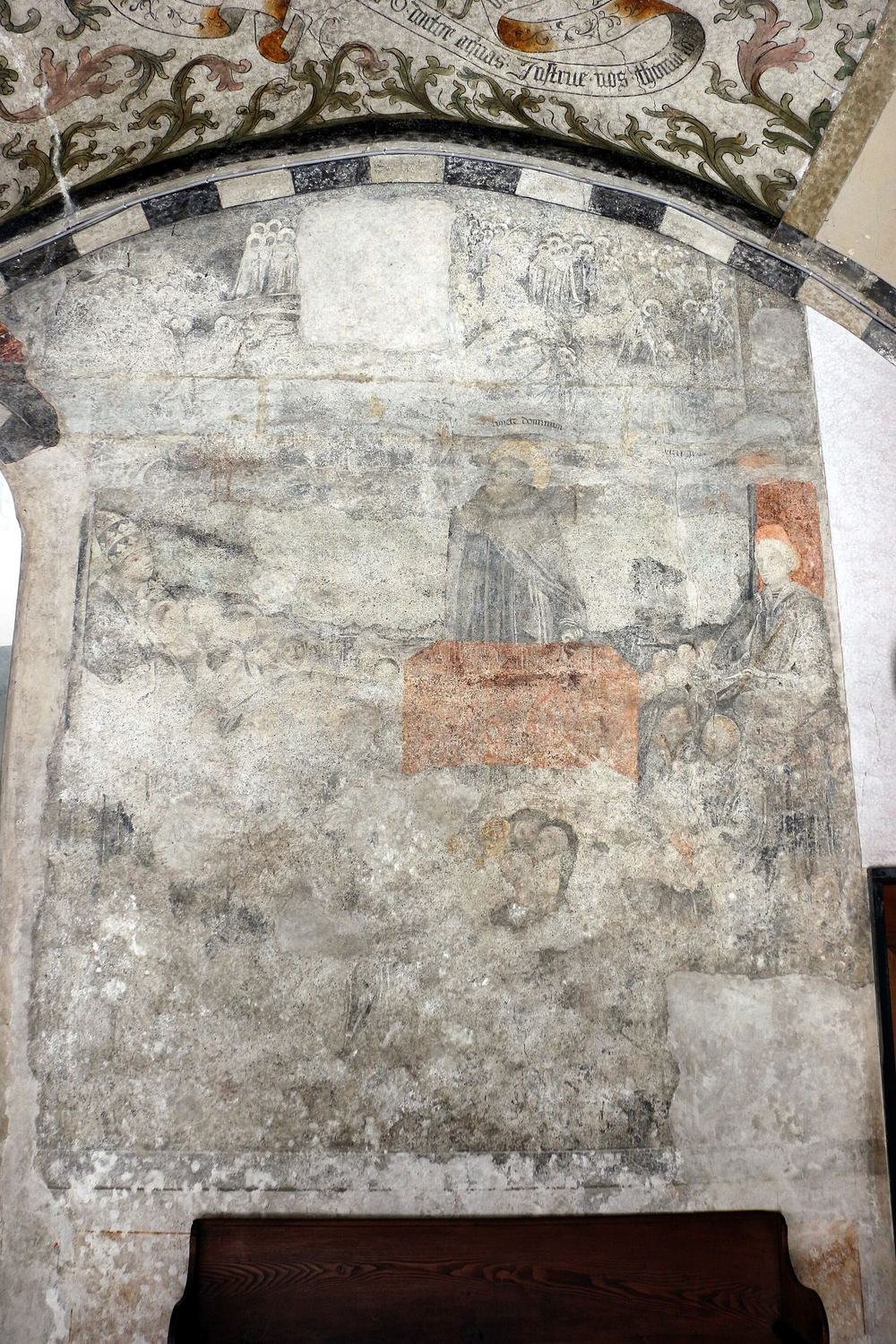
During the Western Schism, Latin Christendom came to have two and even three rival popes. For many years Vincent Ferrer remained faithful to the Avignon obedience and to Pedro de Luna, Benedict XIII, in whose circle he served as friend and counsellor.
In time he placed the unity of the Church above that personal loyalty. He urged Benedict to resign so that union might be achieved, and Benedict refused.
On 6 January 1416, at Perpignan, at the behest of King Ferdinand I, he proclaimed the Crown of Aragon’s withdrawal of obedience from Benedict XIII. It was a decisive step in bringing the Spanish kingdoms into the Council of Constance, which ended the Schism with the election of Martin V in 1417.
According to most studies, he did not attend Constance in person; his contribution was to open the way to union from within the Crown of Aragon.
1412
When Martin the Humane died without an heir in 1410, the Crown of Aragon was left without a king and with several claimants. To avoid war, the decision was entrusted to nine arbiters, three from each realm: Aragon, Catalonia and Valencia.
Vincent Ferrer was one of them, as was his brother Boniface, Prior of the Charterhouse. In 1412 his vote went to Ferdinand of Antequera, of the House of Trastámara, who was proclaimed king.
Tradition often credits him with a decisive role in the outcome. Historians qualify that prominence and continue to debate the Compromise, but they agree on something of real worth: a disputed succession was settled by agreement rather than by arms.
Doctor de la Paz
Wherever he preached, chronicles and testimonies speak of factions reconciled, family feuds healed and cities brought to peace. For him, personal conversion and social peace were inseparable.
That is why the cause proposes for him the title Doctor de la Paz: a teaching that unites faith, reform of life and concord, and that speaks to our own age as well. His declaration as a Doctor of the Church has not yet been made and belongs solely to the Holy Father.
He chose unity over personal loyalty.
He helped bring about a negotiated succession.
He reconciled warring factions and feuding families.